How Drones Learn to Fly Through Moving Gaps
Flying a drone through a narrow opening is difficult enough. But what if the opening is moving? A new learning-based approach enables autonomous drones to master this challenging manoeuvre using only their onboard sensors – after just minutes of training in simulation.
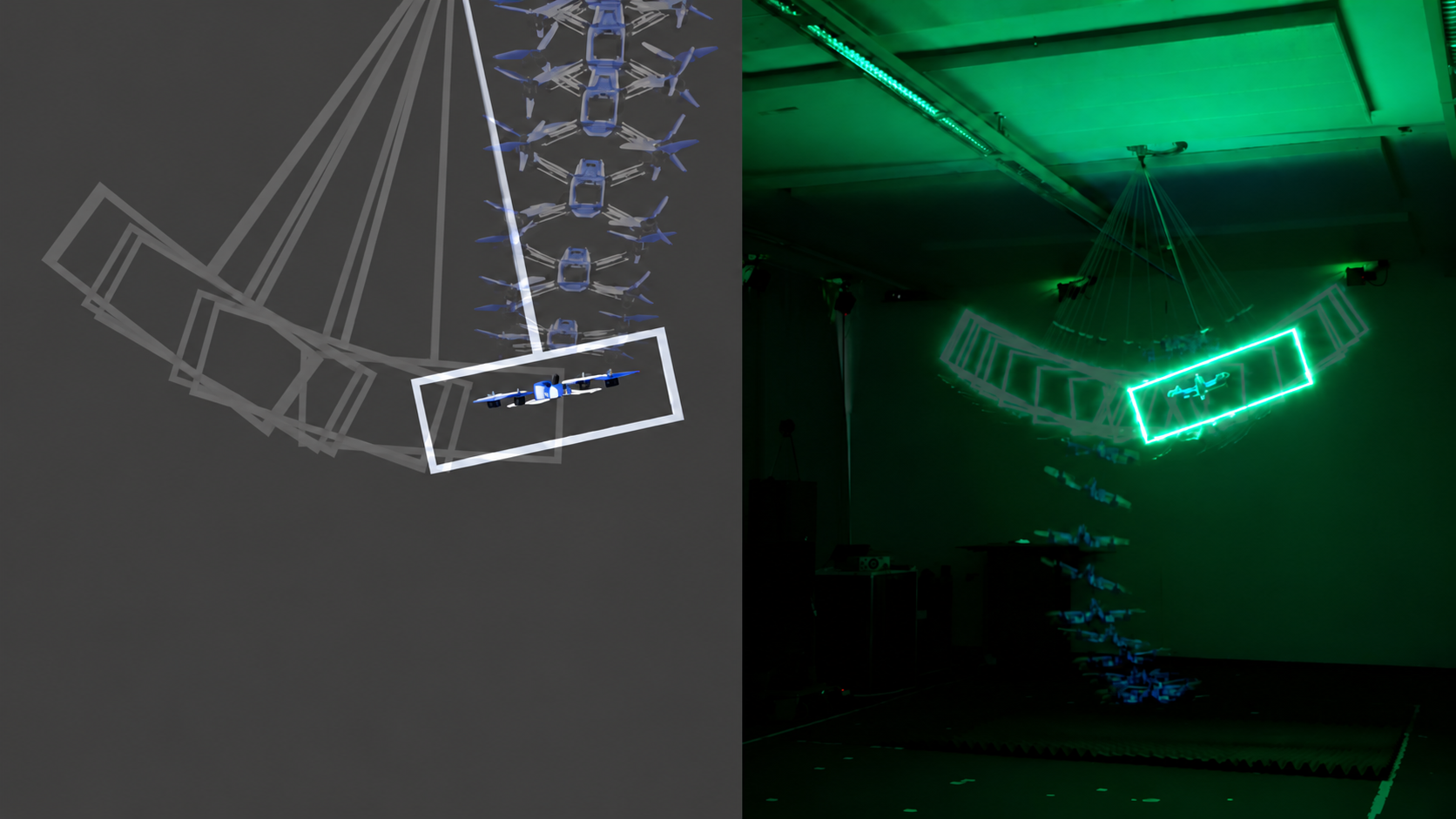
Flying through a moving narrow opening requires extraordinary precision. An autonomous drone must continuously adjust its position, speed and timing to avoid collisions – all while relying on the information it gathers during flight.
The Robotics and Perception Group (RPG), led by Prof. Dr. Davide Scaramuzza, has developed a new approach that enables drones to learn this challenging manoeuvre through simulation, without expert demonstrations or predefined flight plans.
Learning faster through simulation
The key innovation lies in how the drone learns. Rather than simply receiving feedback on whether a flight was successful or not, the training method provides information that helps it improve its positioning, timing and collision avoidance.
Using a technique called differentiable simulation, the researchers can train the drone's control system from scratch in just minutes on a single graphics processor. Compared with a commonly used reinforcement learning method, the approach requires 20 times fewer training transitions and 40 times less training time.
From simulation to real-world flight
The system achieved a success rate of approximately 99% in simulation. When transferred to a real drone without additional training, it successfully passed through the moving opening in 80% of test flights.
During these experiments, the drone relied exclusively on its onboard camera and motion sensors to navigate. The results demonstrate how efficient simulation-based learning can enable autonomous drones to perform precise manoeuvres in dynamic environments.
The study, “Learning Visuomotor Quadrotor Flight Through Dynamic Narrow Gaps via Differentiable Simulation”, was presented at the Conference on Robot Learning (CoRL) 2026. It was conducted by Riccardo Bianco, Yunfan Ren, Jiaxu Xing, and Davide Scaramuzza.
Further information