PhD Defense: Paul Friedrich
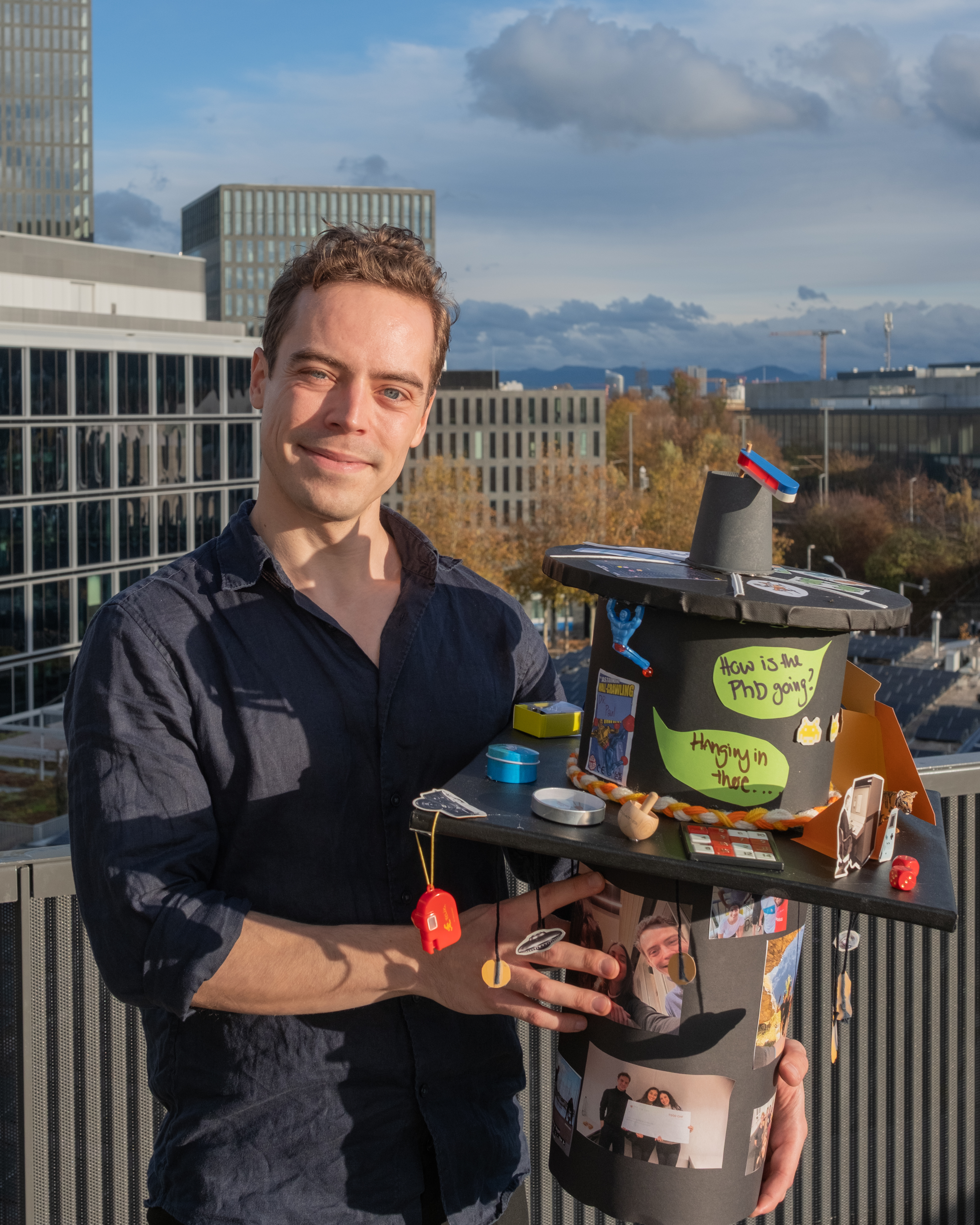
Congratulations to Paul Friedrich on successfully defending his PhD thesis, “From Guarantees to Governance: Allocation and Collusion in the Age of Adaptive Agents”! 🎉
As algorithms and AI agents increasingly make decisions on our behalf, an important question arises: How can we ensure that they act not only in their own interests, but also in the interests of society?
In his doctoral research, Paul Friedrich explored how the rules governing economic interactions can be designed to encourage autonomous agents to act in ways that benefit society.
One focus of his work was air traffic management for drones. As the number of autonomous delivery drones grows, coordinating their movements becomes increasingly challenging. Paul showed that approaches currently favoured by regulators may struggle to cope with large numbers of drones. He developed alternative mechanisms that combine economic principles with efficient path-finding algorithms, enabling the coordination of thousands of drones while encouraging them to follow the system's rules.
Another part of his research examined how AI agents behave in markets. He showed that reinforcement learning systems and large language models can form price-fixing cartels without communicating directly, making such behaviour difficult to address under existing competition laws, which typically focus on explicit agreements. His findings also revealed that these agents can learn to exploit regulatory measures intended to prevent such behaviour.
Paul's research highlights the need to rethink economic rules and institutions that were originally designed for human decision-makers. As AI agents become increasingly autonomous, these systems must account for their ability to learn, adapt and cooperate in unexpected ways.
Paul conducted his doctoral research in the Autonomous Learning and Predictive Intelligence (ALPI) lab under the supervision of Prof. Dr. Giorgia Ramponi.