Personalized Ranking: Human Preference Elicitation for Multi-Criteria Decision Making
Project Background
Ranking is everywhere! Everyday decisions require ranking thousands of items by multiple, often conflicting, criteria. Whether choosing a university, buying a car, or selecting a vacation destination, users need support.
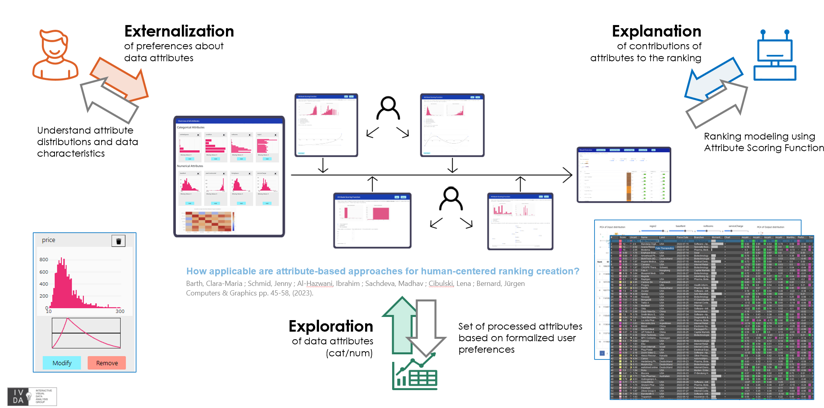
Current human-centred ranking approaches generally fall into two categories: Item-based feedback (where people give feedback on specific item preferences) or Attribute-based feedback (where people weigh specific criteria). However, comparing complex items to create a ranking is non-trivial. Relying solely on one type of feedback often fails to capture the user's true intent. A visual interface that bridges the gap between item granularity and attribute granularity is required to address complex decision-making problems. The core research question is: How can we combine item and attribute feedback to best match user preferences?
Project Scope
In this project, we will design, implement, and evaluate an interactive visual tool consisting of a server (Python) and a web interface (React) to support hybrid preference elicitation. The main idea is to build a system where users can provide feedback on items, which updates the attributes, and vice versa (Bidirectional Learning).
The tool should allow users to express their preferences in a visual-interactive way using coordinated views. Based on this feedback, the tool will utilize ML/AI algorithms to provide instant rank updates, offer explanations, and highlight conflicts in the user's feedback.
In short, the project consists of the following:
-
A literature review of existing approaches for multi-criteria decision making and preference elicitation.
-
The design and implementation of a visual interface with coordinated views for combined item and attribute feedback.
-
Implementation of ranking algorithms/ML to model the learning process (Items -> Attributes; and Attributes -> Items).
-
Evaluation of the tool via a user study to validate the effectiveness of the combined approach.
Organizational Information
The project will be supervised by Aman Kumar and Prof. Jürgen Bernard. The start date is flexible (targeting February 2026 or as discussed). A group of 3-5 students will be working on the project.
The project language is English; therefore, you are required to have good English knowledge (written and oral).
The programming languages are chosen to support data science workflows and modern web standards: Python for the back end (data processing/ML) and React.js for the front end. The code will be versioned through GitLab.
The ultimate goal of the project is to submit a paper upon completion; therefore, students with a research interest are preferred. In case of excellence, the study might result in a publication.
Your profile
You should have the following skills for this project:
-
Full-Stack Development: Strong skills in web development (React.js for front-end components).
-
Data Science: Proficiency in Python-based data science workflows.
-
Visualization: Proven experience developing data visualizations or visual interfaces.
-
Machine Learning: Background in ranking algorithms, data processing, or preference learning.
- Experience in working with version control systems (e.g. Git, we will be using GitLab)
- Interest in research
In addition, it would be nice if you have experience in one of the following areas (but it is not a must):
- UI / UX design
- Testing (e.g. Unit Testing)
- REST or any other framework that supports the communication between the back and front end
- CSS and HTML
- Front end frameworks such as ReactJS, Angular, Material Design, Bootstrap, etc.
- Back end frameworks such as Django, Flask, Spring, etc.
How to Apply / Contact
The topic will be assigned through the "Master Project Market" in Fall 2025. Watch out for the event so that you don't miss it!
Interested students should send their complete application directly to Aman Kumar (aman.kumar@uzh.ch) and Prof. Jürgen Bernard (juergen.bernard@uzh.ch).
Applications should include:
- A short, informal letter of motivation including your expectation for the project, the skills you want to learn, and your experience with data visualizations (if any)
- Your CV
- Your transcript of records from your Master's and Bachelor's Degree
If you have any questions about the project, please feel free to contact Prof. Jürgen Bernard or Aman Kumar.